Claude Skills From GitHub Know Things. Nobody Checks If They Still Do.
Claude skills on GitHub are folders, each holding a SKILL.md file with a name, a description and instructions. Anthropic's own live at github.com/anthropics/skills. Copy one in and Claude follows it. What no skill does by itself is notice when the facts inside it go out of date. That review job is the co-founder part.
Where do I find Claude skills on GitHub?
Start at github.com/anthropics/skills. That is Anthropic’s own collection, published alongside Agent Skills in October 2025.
Their README puts it plainly: “Skills are folders of instructions, scripts, and resources that Claude loads dynamically to improve performance on specialized tasks.”
Each skill is one folder with a SKILL.md file in it. The frontmatter needs two fields, name and description. Claude reads the description to decide when the skill applies, then reads the rest when it does.
That is the whole format. You can write one in ten minutes. A great many people have, and GitHub is full of them.
So, can you not just ask Claude?
Mostly, yes. Plain Claude plus a decent skill does the job on the day you install it.
The trouble starts on a later day.
What goes wrong with a skill nobody reviews?
A useful skill holds two kinds of thing.
Method: how to do the job. Which steps, in what order, what to check.
Facts: the numbers the job depends on. Thresholds, rates, deadlines, dates a rule starts.
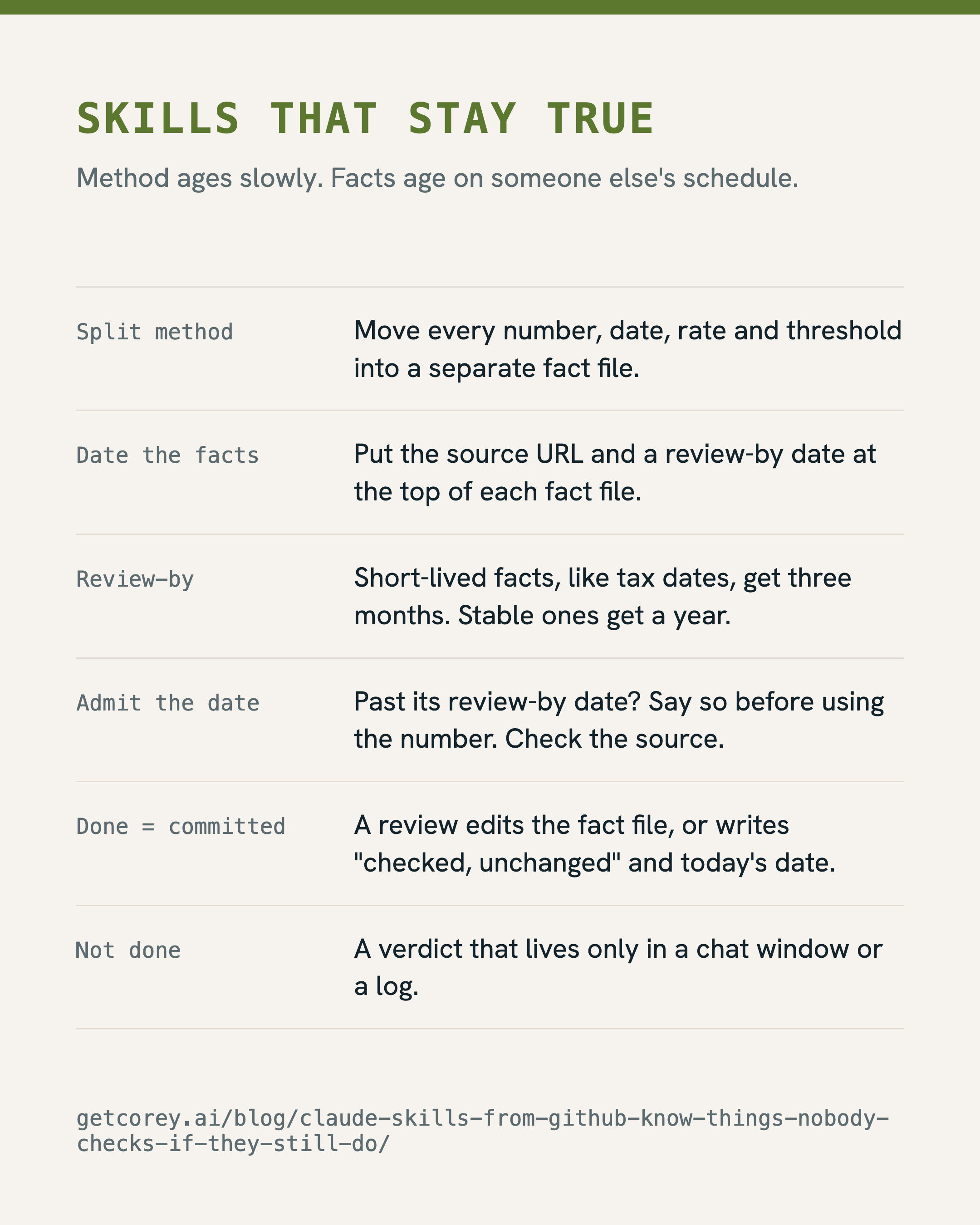
Method ages slowly. Facts age on someone else’s schedule. HMRC does not open a pull request on your repo when it changes its mind.
Plain Claude has a training cutoff, and it will tell you about it if you ask. A skill file has a cutoff too. It just never mentions it.
Call this the confident file. Written once, correct on the day, never opened again, and quoted with total assurance for ever after.
You have one somewhere. A Notion page with last year’s VAT threshold. A pricing doc with a supplier’s old rate. A README explaining a deploy step that stopped existing in spring. I would bet on it.
The danger is not that the file is old. It is that a skill reads it and repeats it in a calm, competent voice. Nothing about the answer looks stale.
How a confident file caught us this week
We keep our tax and finance knowledge as plain files that skills read. Each one carries a review date. On 09/10/2026, eleven of them were overdue, and a ticket went into the queue to re-check them against gov.uk.
One of those files says mandatory payrolling of benefits in kind starts in April 2026.
HMRC delayed that to April 2027 back in April 2025. It has since split it in two: from 6 April 2027 only company cars, car fuel, vans, van fuel and employer-provided medical benefits, with most other benefits from April 2028 (gov.uk, “The phased introduction of mandatory payrolling for benefits in kind”).
So our file describes a rule that, by its own account, has been in force for six months. It has not started at all.
Since then, an agent has picked up that review ticket six times. Twice in the small hours, once at 08:46 on 12/10/2026. Every run ended the same way: no commit, no handoff, nothing written back to the file.
As I write this, the file still says April 2026. The review has been started six times and finished none. That is the confident file with an extra layer on top: the work has visibly been attempted, so it feels handled.
What does an AI co-founder do that plain Claude does not?
The expected answer is that it knows more.
It does not. It knows the same things, from the same kind of files you can get from GitHub.
The difference is that it keeps a date on what it knows, and treats that date as a deadline.
Plain Claude answers the question you asked. A co-founder also asks the question nobody asked: is this still true? That is the part Corey adds inside Claude: knowledge packs, each with its sources and a review date by which it must be re-researched.
This week taught us a third piece, the hard way.
The review is not finished when the agent has checked. It is finished when the file has changed.
A check that never reaches the file is worth exactly the same as no check at all. Possibly less, because now someone thinks it was done.
How do I add this to the skills I already use?
Four steps. None needs anything you do not already have.
- Split method from facts. Open each
SKILL.mdyou rely on. Move every number, date, rate and threshold into a separate file the skill points to. The skill keeps the steps. - Date the facts. At the top of each fact file, add the source URL and a review-by date. Short-lived facts, like tax dates, get three months. Stable ones get a year.
- Make the skill admit the date. Add one line to
SKILL.md: if a fact file is past its review-by date, say so before using the number, and check the source first. This gives your skill the habit plain Claude already has about its own cutoff. - Done means committed. A review either edits the fact file or writes “checked, unchanged” and today’s date into it. Never a verdict that lives only in a chat window or a log.
Step four is the one that looks optional.
It is the one we skipped.
Six times.