What an AI co-founder is, and what it is not
An AI co-founder is an AI that holds a standing job in your business, with your facts, your rules and limits it will not cross, instead of answering whatever you type that day. It is not a person, not autopilot and not a smarter chatbot. The difference shows on dull work, like knowing who owes you money.
You already have an AI that can read an invoice.
Claude will read a PDF, total a column and draft a polite chase email faster than you can find the PDF. That part is solved.
What it does not have is a job.
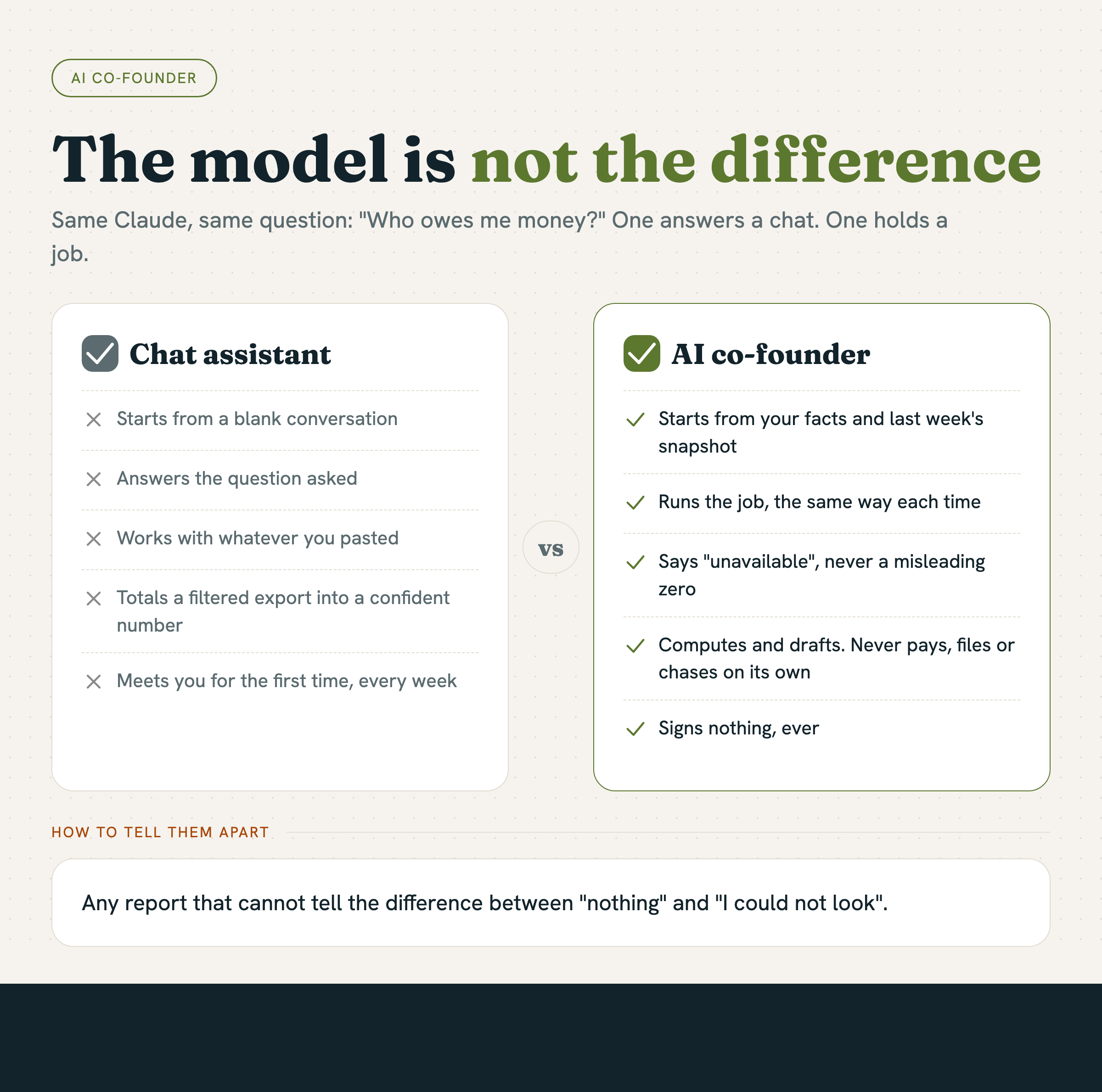
An AI co-founder is an AI that holds a standing job in your business. It knows your facts, follows your rules, and has a short list of things it will not do. A chat assistant answers the question you typed today. A co-founder owns the question you should be asking every week, and knows what a good answer looks like.
That sounds like a slogan. So here is the same job, run twice.
What is an AI co-founder, in one line?
An AI co-founder is a model plus three things the model does not ship with:
- Your facts. Your VAT quarter, your year end, where your ledger lives.
- A method. The steps for a recurring job, written down once instead of retyped every time.
- Boundaries. What it may compute, what it may draft, and what it must never send, pay or sign.
Remove any one of the three and you are back to a very clever stranger.
The model is not the difference. In my case the model is Claude. Anthropic shipped Agent Skills on 16/10/2025 (Anthropic, “Introducing Agent Skills”): folders of instructions Claude loads when a task needs them. That is the mechanism. I did not build it. What I add is the layer on top: the methods, the facts and the boundaries for running a small company.
What does plain Claude do when you ask “who owes me money?”
Before. You run a one-person business. You invoice clients from your accounting software. Some pay on time. Some treat your due date as an opening offer.
You are not alone in that. Four in five smaller UK businesses in supply chains say they have been paid late, and a third say at least a quarter of what they are owed arrives late (FSB research, reported by Scottish Construction Now).
The ask. You open Claude and type: “Who owes me money?”
The output. Claude does the sensible thing. It cannot see your books, so it asks you to paste them, or it explains how to build an aged-debtors report. Both are good answers to a question asked cold.
So you export a CSV and paste it in. Claude totals it beautifully.
Here is the catch. It totals whatever you gave it. If the export was filtered to last quarter, or your bank feed stopped syncing on the 3rd, the total is still a confident, well-formatted number. Nothing in the conversation knows what the full picture should look like, so nothing can notice that part of it is missing.
Next week you do it all again. Same paste. Same explanation of what “due” means. The model is brilliant every single time, and every single time it is meeting you for the first time.
What does the same ask look like when it is a job?
Same words: “Who owes me money?”
This time a skill called bills-obligations picks it up. It is the obligations half of Corey’s finance work, and it has a fixed method:
- Read the ledger, read-only, and record the date it was last reconciled to.
- Sort every unpaid sales invoice into ageing buckets: current, 1-30, 31-60, 61-90 and 90+ days past due.
- List the overdue ones, oldest first. That is the draft chase list.
- Work out what you owe and when, across 30, 60 and 90 days.
- Put dates on the statutory deadlines, resolved against your own year end and VAT quarter, never hard-coded.
- Check each upcoming tax bill against the money you set aside for it, and flag any that fall short.
- Write a new dated snapshot. Never overwrite the last one.
The output for a made-up business looks something like this:
As of 19/10/2026 - ledger reconciled to 18/10/2026

Owed to you:   current £2,400 | 1-30 £1,150 | 31-60 £800 | 61-90 £0 | 90+ £0
Overdue:       3 invoices, £1,950. Oldest: 52 days past due. Chase drafts ready.
You owe:       next 30 days £640
Next deadline: VAT return, due in 18 days. Reserve covers it.
Bank feed:     UNAVAILABLE - token expired. Payments after 14/10 not counted.
Look at the last line. That is the whole post, really.
Why does “unavailable” matter more than the number?
Because a missing source and a zero look identical on a dashboard.
If the bank feed is down, an invoice that was paid yesterday still looks unpaid. Or the reverse: a provider that answered nothing gets totalled as nothing owed. Either way you get a tidy number that is wrong in a direction you cannot see.
So the method has a rule: a figure whose source is missing is shown as unavailable, never as a zero.
It is the most common way a report misleads. Picture a monthly goal on a dashboard: sign-ups, say. The month ends and the number is not low. It is not there, because nothing you connected can count it. Had the tile shown 0, you would have read it as a bad month and moved on. In fact you spent a month steering by an instrument that was not plugged in, and it never once showed a bad reading.
You have this somewhere. I would bet on it. A dashboard tile reading £0 for an integration that disconnected in the spring. A “no overdue invoices” report that means “no invoices synced”. A green tick that is green because nothing ran.
The pattern to spot: any report that cannot tell the difference between “nothing” and “I could not look”. Ask your tools the second question, not just the first.
Why does this matter for invoices in particular?
Late money is not a rounding error for a small firm. Slow and late payment closes 38 UK businesses a day and costs the economy £11bn a year, according to figures cited by Tina McKenzie of the Federation of Small Businesses (Printweek, October/November 2025).
The fix for late payment is boring. You chase early, you chase in order, and you know your own position before a tax bill lands. None of that needs genius. It needs the same question asked the same way every week, by something that remembers last week’s answer.
That is the job. A co-founder is the thing that holds it.
What is an AI co-founder not?
This is the half people skip, and it is the half that keeps you safe.
| Chat assistant | AI co-founder | What it is not | |
|---|---|---|---|
| Starts from | A blank conversation | Your facts and last week’s snapshot | Your memory of what you meant |
| Does | Answers the question asked | Runs the job, the same way each time | Decides what your business is for |
| Missing data | Works with what you pasted | Says “unavailable” | Guesses |
| Money | Can draft an email | Computes and drafts | Pays, files or chases on its own |
| Signs | Nothing | Nothing | Anything, ever |
The bills-obligations skill has a hard limit: it computes and it records. It does not chase, pay or file. Drafting a chase is safe. Sending one is held for a human.
An AI co-founder is also not a person. It does not carry your liability, it cannot sign a contract, and it will not tell your accountant they are wrong at a dinner party. It is not autopilot either. The point of the boundaries is that you stay the one who decides, with a much better view of what you are deciding about.
And it is not a smarter model. The model is the same Claude you already have. If Claude were the bottleneck, a co-founder would not help.
Can I not just ask Claude?
Yes. Honestly, yes.
Everything in the method above is something you could type into Claude yourself. A skill is that typing, done once, kept in a file, with your facts beside it and the boundaries written down. The value is not that the instructions are secret. It is that you never have to remember to give them, and they do not drift each time you paraphrase them at 11pm.
If you want to test any setup, yours or ours, ask it one question about money and then break something on purpose. Disconnect a feed. Hand it a half-filtered export. See whether it tells you, or hands you a confident number anyway.
What it says when the data is not there tells you more than any answer it gives when the data is.
FAQ
Is an AI co-founder the same as a chat assistant?
No. A chat assistant answers what you ask in the moment. A co-founder holds recurring jobs, with your facts, a written method and limits on what it may do. The same model can be either; the difference is what sits around it.
Does an AI co-founder replace my accountant?
No. It computes positions and drafts. It does not give regulated advice, file returns or pay anyone. Treat its output as a well-kept working file you bring to your accountant, not a substitute for one.
What do I need to use Corey?
A paid Claude plan, usually Claude Pro, or Cursor on its free tier. Corey itself is free for individuals. It runs inside the AI tool you already use, as skills and knowledge loaded into it, rather than as a separate app.
Will it send chase emails for me?
It drafts them, sorted oldest-overdue first. Sending stays with you, because anything outward-facing that involves money goes past a human first.