 Corey
CoreyYour VAT Return Adds Up. That Is Not the Same as Right.
To file a VAT return with Claude, have it total the nine boxes from your categorised records, then make it list every line it would not bet on: entertainment, missing VAT invoices, overseas software needing the reverse charge. The boxes always add up. The exceptions list is where the return actually gets checked. You file through MTD software.
Can Claude file my VAT return?
Not quite, and the part it cannot do is not the part that goes wrong.
Since 1 April 2022, every VAT-registered business in the UK has had to file through Making Tax Digital compatible software (HMRC, Making Tax Digital for VAT). Claude does not press that button.
What it can do is the three months of work behind the button. Categorise. Total. Reconcile. And tell you which lines it would not bet on.
Most people ask for the first three and skip the fourth. That is what this post is about.
Why does a wrong VAT return still add up?
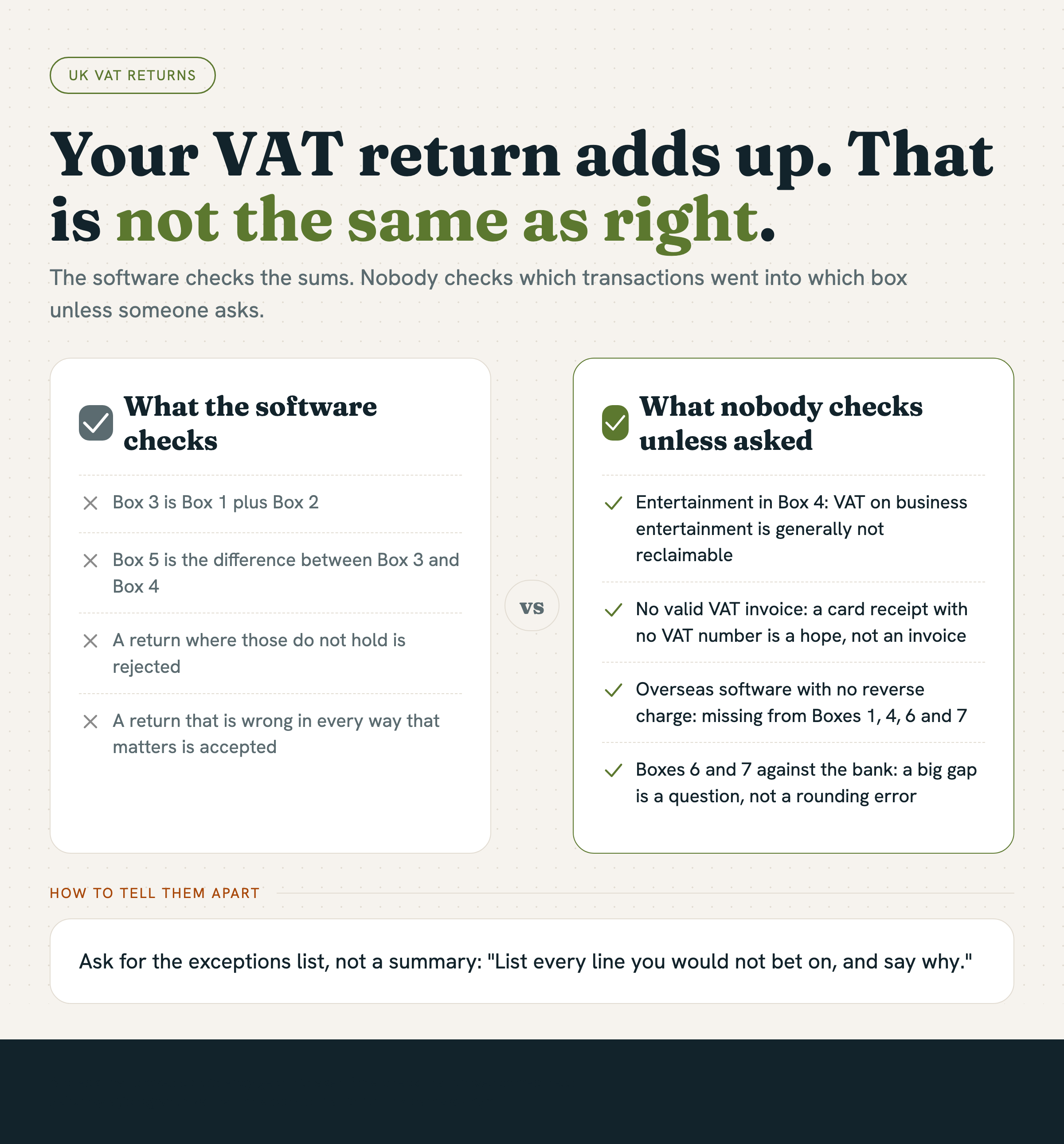
A VAT return checks itself. Box 3 is Box 1 plus Box 2. Box 5 is the difference between Box 3 and Box 4. The software, and HMRC’s API behind it, will reject a return where those do not hold.
It will accept one that is wrong in every way that matters, as long as the sums work.
Because the arithmetic is the only part anything checks automatically, the arithmetic is the part that is always right. The errors live one level down, in which transactions went into which box. Three turn up constantly:
- Entertainment in Box 4. VAT on business entertainment is generally not reclaimable (HMRC VAT Notice 700/65). There is a client lunch in your Box 4 somewhere. I would bet on it.
- No valid VAT invoice. You can only reclaim VAT you can evidence with a proper VAT invoice (HMRC VAT Notice 700). A card receipt that says “VAT incl.” with no VAT number is a hope, not an invoice.
- Overseas software with no reverse charge. Buy a subscription from a supplier outside the UK and you usually account for the VAT yourself: the same amount in Box 1 and Box 4, the value in Boxes 6 and 7 (HMRC VAT Notice 741A). For most businesses the net effect is zero. It is still an error when it is missing, which makes it the most annoying kind. Wrong, and not even profitably wrong.
None of these breaks a single sum. That is the pattern worth learning to spot:
A check that proves consistency gets mistaken for a check that proves correctness.
What does that look like outside tax?
We found the same shape in our own system this week.
We run scheduled jobs that call a model and write the result somewhere. On 26/09/2026 we found one that had been reporting outcome=ok while every model call it made had failed. Not most of them. Every one.
The job started. The job finished. The job exited cleanly, and the status file recorded a success, because “did the process reach the end” was the only question anyone had taught it to ask. By that measure it was the most reliable thing we run.
The fix was not cleverer logging. It was a second question: did the thing the job exists to produce actually get produced? A clean exit with nothing to show for it now counts as a failure.
Your VAT return has the same two questions. Do the boxes agree with each other? And do the boxes agree with what actually happened? Software answers the first one for free. Nobody answers the second unless someone asks.
How do you file a VAT return with Claude, step by step?
- Start from categorised records, not a bank statement. MTD requires digital records anyway. Give Claude the quarter’s transactions with a category and a VAT amount on each line.
- Have it total the nine boxes. This is the easy part, and the part it will do perfectly.
- Ask for the exceptions list, not a summary. The prompt that matters: “List every line you would not bet on, and say why.” Name the three classes above so it knows what doubt looks like.
- Reconcile against the bank. Boxes 6 and 7 should roughly match what went in and out, net of VAT and of items outside the scope of VAT. A big gap is a question, not a rounding error.
- Make the judgement calls yourself, or with your accountant. What is reclaimable is a decision, not a sum.
- File through MTD-compatible software. The return and the payment are usually due one calendar month and seven days after the period ends (GOV.UK, VAT Returns).
The fuller walkthrough, box by box, is in how to do your VAT return with AI.
Can I not just ask Claude?
You can, and step 3 is where it gets interesting.
Plain Claude will total your boxes happily. Whether it volunteers the exceptions depends on whether you remembered to ask this quarter, and whether you remembered which of your suppliers is in America.
That is the job Corey’s finance skills exist for. Corey runs inside the Claude you already use and works from records in a folder you own. The exceptions list is part of the job, not a prompt you have to remember late on the 6th. Last quarter’s reverse-charge suppliers are in the folder because last quarter’s notes are.
It does not file for you, and it is not tax advice. It hands you a return with the doubts on top.
What happens if you find a VAT error after filing?
Less than it feels like at the time.
Net errors below £10,000, or up to 1% of your Box 6 figure capped at £50,000, can usually be corrected on your next return instead of by separate disclosure (HMRC VAT Notice 700/45). Above that, you tell HMRC separately.
Late filing is the other risk. Since 1 January 2023, a quarterly filer gets a penalty point for each late return, and at four points a £200 penalty (GOV.UK, VAT penalties and interest).
So a return that adds up and goes in on time is not the goal. It is the minimum.
The goal is the list of lines nobody would bet on. Whoever does your return, human or model, should hand you one.